

Table of Contents
Total Physical Response (TPR)
Total Physical Response is a language teaching method based on the assumption that the coordination of speech and action will boost language learning.
It was developed by James Asher in the 1970s. He drew from various fields, including psychology, learning theory, and humanistic pedagogy.
Psychological Foundations
Trace Theory of Memory
According to the trace theory of memory in psychology, the more often and intensively a memory is traced, the stronger the memory association will be, and the more likely it will be recalled. The retracing can be verbal through repetition and/or in association with motor activity.
This is reminiscent of behavioristic psychology, which holds a Stimulus-Response model of learning. The stimulus in the TPR method is verbal, and the response is physical. In this respect, Total Physical Response has many similarities to the Direct Method.
Developmental Psychology
From developmental psychology, Asher draws a parallel between first language acquisition and second language learning. Children acquire language through a series of commands from their parents to which they react physically. It’s only later that they can produce verbal responses (cf. Jean Piaget’s works).
Asher contends that humans are endowed with a sort of bio-program that follows this process of language learning and that, when teaching a second language, we must follow the same process for successful learning.
In this respect, Asher adheres to a naturalistic method of language learning (cf. Krashen’s Natural Approach). Language learning must focus on comprehension, and the teaching of speaking must be delayed until comprehension skills are established.
Asher also believes that the skills acquired through listening transfer to other skills and that meaning precedes form.
Language Assumptions
Asher’s method relies on three assumptions about language:
1. Use of Imperatives
First, Asher thinks that many grammatical structures and vocabulary items can be learned through the skillful use of the imperative form. In his view, verbs in the imperative are fundamental forms upon which language learning can be organized.
Command drills can serve as a vehicle for the internalization of many language structures and vocabulary.
2. Abstractions vs. Non-Abstractions
Another TPR assumption about language is the distinction between abstractions and non-abstractions. According to Asher, abstractions are not necessary to teach beginners.
Non-abstractions, on the other hand, can help build a detailed cognitive map and grammatical structure of the language.
3. Language Chunks
The third assumption states that language can be internalized not only as single items but also as wholes or chunks.
This idea was later developed by Michael Lewis (1993) in his Lexical Approach.
Humanistic Pedagogy
Relying on humanistic pedagogy, TPR also stresses the importance of a stress-free environment. Second language learning often causes a lot of stress and anxiety.
However, if teachers focus on meaning transferred into physical activity rather than on abstract language forms, students are freed from stress and anxiety.
Features of Total Physical Response
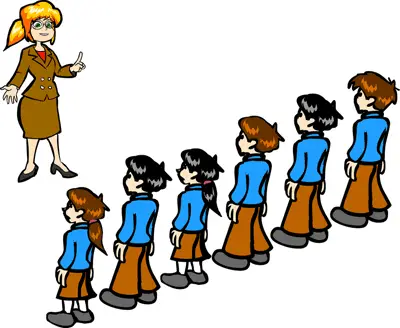
In a nutshell, here are the most salient features of TPR:
- The coordination of speech and action facilitates language learning.
- Grammar is taught inductively.
- Meaning is more important than form.
- Speaking is delayed until comprehension skills are established.
- Effective language learning takes place in a low-stress environment.
- The role of the teacher is central. They choose the appropriate commands to introduce vocabulary and structure.
- The learner is a listener and a performer responding to commands individually or collectively.
- Learning is maximized in a stress-free environment.
TPR Activities
Activities in the TPR method rely on action-based drills in the imperative form. Imperative drills are introduced to elicit physical/motor activity from the learners. The use of dialogs is delayed. Typical classroom activities include:
- Command drills.
- Role plays in everyday situations (at the restaurant, at the movies, etc.)
- Slide presentations to provide a visual center for the teacher’s narration, which is followed by commands or questions
- Reading and writing can also be introduced to further consolidate grammar and vocabulary and as follow-ups.
Criticism
- Asher doesn’t provide a detailed account of his distinction between abstractions and non-abstractions. For example, as Richards and Rodgers (1986: 88) state, are tense, aspect, and so forth abstractions, and if so, what sort of detailed cognitive map could be constructed without them?
- TPR deals with only the beginning stages of language learning.
- The TPR syllabus and the utterances and sentences within it are questionable in terms of their communicative relevance.
Advantages
- When used in association with other methods and techniques, TPR can yield tremendous results.
- For many teachers, TPR represents a useful set of techniques and is compatible with other approaches to language teaching.
- The focus on comprehension is another appealing feature of TPR.
- The method is compatible with new approaches to language learning as it stresses the importance of meaning rather than form.
- Learning highly benefits from TPR’s emphasis on stress reduction.
References
- Richards, Jack C., and Theodore S. Rodgers (1986). Approaches and Methods in Language Teaching: A Description and Analysis. Cambridge: Cambridge University Press.
- Brown, H. D. (2000). Principles of Language Learning and Teaching (4th ed.). New York: Longman.
Other Sources