
Table of Contents
Grammar Exercises: Plural Nouns
Ready to master plural nouns in English? These free plural nouns exercises with answers will help you practice both regular and irregular forms. Designed for beginners and ESL learners, these activities let you test your grammar skills, check your answers instantly, and learn from your mistakes.
If you struggle with plural noun spelling rules or irregular forms, don’t worry — these exercises are easy to follow and fun to complete!
👉 Tip: If you’re unsure, scroll down to the Quick Reference Table for help with common plural patterns.
Plural Nouns Exercises (Regular & Irregular Forms)
Try the exercises below on plurals and click the button to see the correct answer. Before doing the exercises, you may want to read the lesson on Plurals

Instructions
Practice forming plural nouns by completing the sentences and writing the correct answers. These exercises will help you master both regular and irregular plural forms. After completing the tasks, review your answers and learn from any mistakes.
- Read each sentence carefully and write the correct plural form.
- Check your answers after finishing the exercises.
- Pay attention to spelling, punctuation, and capitalization.
- Use the Quick Reference Table below if needed.
💡 Tip: Remember, not all plural nouns follow the same rules. Review irregular forms often to improve accuracy.
What Are Plural Nouns in English Grammar?

Plural nouns are used to talk about more than one person, place, thing, or idea. In English, most plurals are formed by adding -s or -es to the singular form. However, some nouns have irregular plural forms that don’t follow standard rules, such as child → children and goose → geese. Knowing these patterns is key to mastering English grammar.
Quick Reference: Regular and Irregular Plural Nouns
Here’s a quick look at some regular and irregular plural nouns you’ll encounter in English:
| Singular | Regular Plural | Irregular Plural |
|---|---|---|
| Boy | Boys | – |
| City | Cities | – |
| Woman | – | Women |
| Sheep | – | Sheep |
| Tooth | – | Teeth |
| Child | – | Children |
| Bus | Buses | – |
| Leaf | Leaves | – |
| Goose | – | Geese |
| Mouse | – | Mice |
FAQs about Plural Nouns & Plural Forms
What is a plural noun?
A plural noun refers to more than one person, place, thing, or idea.
How do you form plural nouns in English?
Most nouns add -s or -es, but some nouns have irregular forms (child → children).
What are irregular plural nouns in English?
Irregular plurals don’t follow standard rules, e.g., tooth → teeth, mouse → mice.
Are there exceptions to plural rules?
Yes, some nouns are the same in singular and plural, like sheep, fish, and deer.
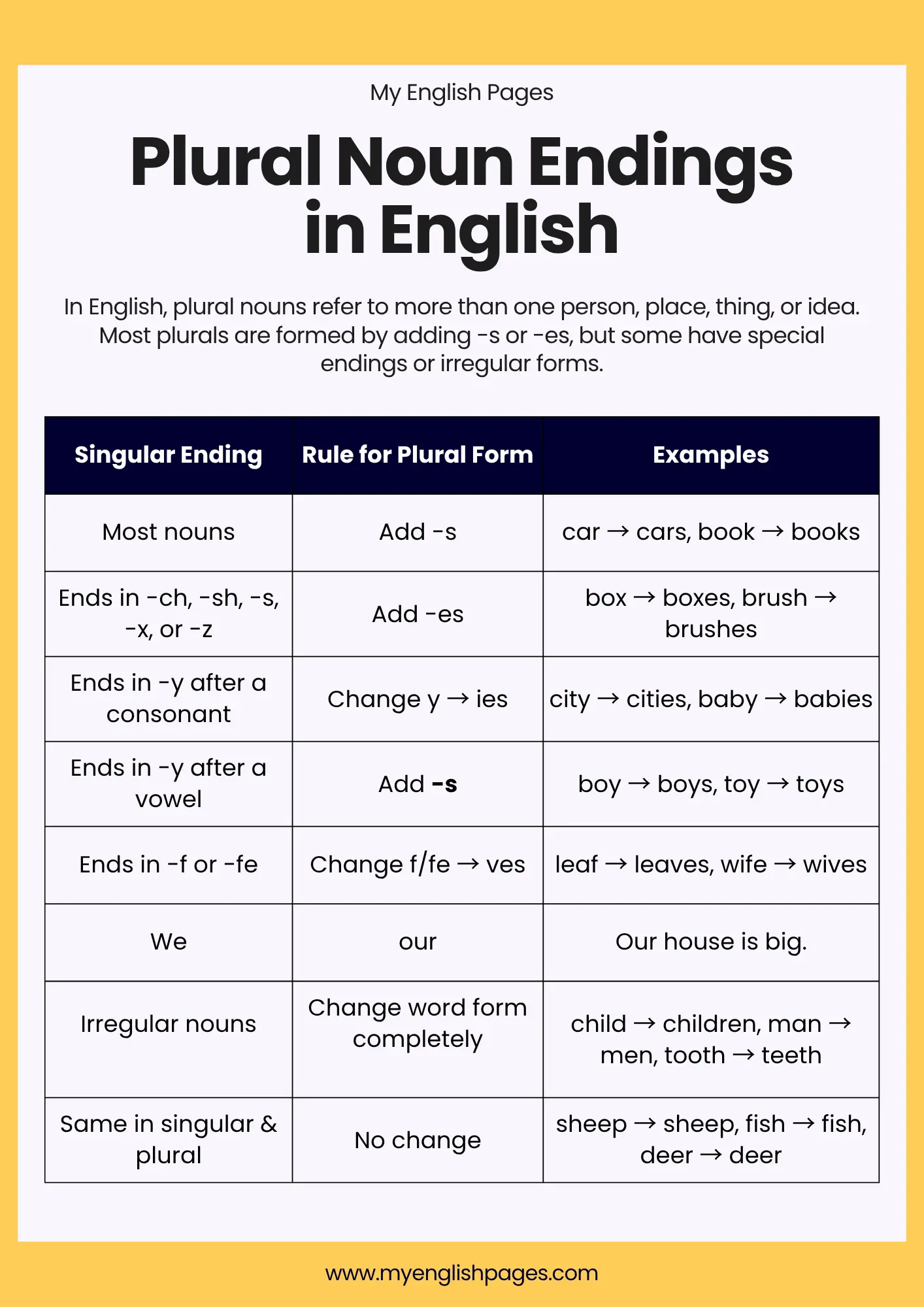
What are the spelling rules for plural nouns?
Plural noun spelling depends on the ending of the singular word.
– Most nouns: add -s → car → cars
– Nouns ending in -ch, -sh, -s, -x, -z: add -es → box → boxes
– Nouns ending in -y after a consonant: change y → ies → city → cities
– Nouns ending in -f or -fe: change f → ves → leaf → leaves
– Irregular forms: child → children, tooth → teeth
Where can I practice plural nouns exercises online?
This page provides free, printable exercises and interactive quizzes to practice both regular and irregular plural nouns.
How can I learn plural forms easily?
Start by learning the basic spelling rules:
– Most nouns → add -s (car → cars)
– Nouns ending in -ch, -sh, -s, -x, -z → add -es (box → boxes)
– Nouns ending in -y after a consonant → change y to ies (city → cities)
– Irregular nouns → memorize their plural forms (child → children).
Then, reinforce your learning with plural form exercises with answers like the ones on this page.