
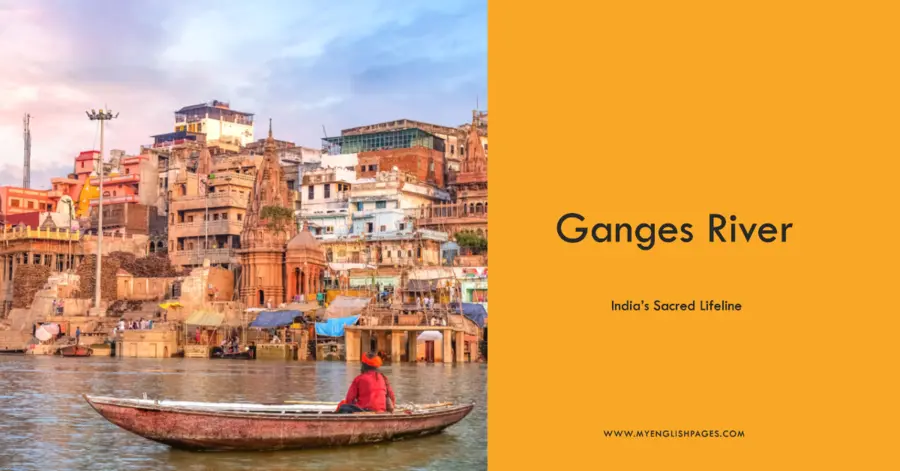
English-speaking Countries – Explore the cultural, historical, and geographical significance of the Ganges River
Table of Contents
Introduction
The Ganges River, also known as Ganga, is one of the most important and iconic rivers in the world. Flowing through India and Bangladesh, it holds immense religious significance, supports millions of lives, and has shaped the culture and history of the Indian subcontinent for centuries.
Where Is the Ganges River?

The Ganges originates in the western Himalayas in the Indian state of Uttarakhand. From there, it flows through the Gangetic Plain of North India, eventually entering Bangladesh and emptying into the Bay of Bengal.
Ganges River Facts
- Total Length: 2,525 km (1,569 miles)
- Countries: India and Bangladesh
- Source Glaciers: Gangotri Glacier, Satopanth Glacier, and others near Nanda Devi and Kedarnath
- Mouth: Bay of Bengal
- Major Tributaries: Yamuna, Ghaghara, Son, Gandak
- Bridges: Mahatma Gandhi Setu, Ganga Rail-Road Bridge
Religious and Cultural Importance
The Ganges is considered the most sacred river in Hinduism. Hindus believe that bathing in the river purifies one’s sins. It is personified as the goddess Ganga, and rituals such as cremations and ashes immersion are performed on its banks.
Fun Fact: Every year, millions of pilgrims visit Varanasi, one of the oldest living cities in the world, to perform religious rites on the Ganges.
Cities Along the Ganges
The river flows through several major cities, including:
- Varanasi – Hinduism’s holiest city
- Haridwar – Site of the Kumbh Mela pilgrimage
- Allahabad (Prayagraj) – Famous for the confluence of the Ganges, Yamuna, and mythical Saraswati
- Kolkata – A major cultural and economic hub
- Patna – An ancient city on the Ganges’ banks
- Kanpur, Ghazipur, Munger, and more
Historical Significance
Throughout history, the Ganges has shaped the rise of civilizations:
- Ancient capitals like Patliputra, Kannauj, and Kashi flourished on its banks
- The river provided water routes for trade and agriculture
- It has been a center of spiritual learning, cultural exchange, and political power
Environmental Challenges
Despite its importance, the Ganges faces serious environmental issues:
- Pollution: Industrial waste, sewage, and religious offerings contribute to poor water quality
- Overuse: Intensive irrigation and urban use strain its flow
- Conservation Efforts: Government programs like Namami Gange aim to clean and rejuvenate the river
Quick Facts Summary
| Feature | Detail |
|---|---|
| Length | 2,525 km (1,569 miles) |
| Mouth | Bay of Bengal |
| Countries | India, Bangladesh |
| Major Cities | Varanasi, Kolkata, Haridwar, Patna, Allahabad |
| Religious Role | Sacred to Hindus; goddess Ganga |
| Source Region | Gangotri Glacier, Himalayas |
| Tributaries | Yamuna, Ghaghara, Gandak |
| Important Bridges | Mahatma Gandhi Setu |
More on the Ganges on Wikipedia
Key Vocabulary
| Word | Definition | Example |
|---|---|---|
| Sacred | Connected with religion and deeply respected | The Ganges is a sacred river for Hindus. |
| Confluence | The point where two or more rivers meet | Allahabad is famous for the confluence of three rivers. |
| Glacier | A large body of ice that moves slowly | The Ganges starts from the Gangotri Glacier. |
| Pilgrimage | A journey to a holy place for religious reasons | Many people go on a pilgrimage to Varanasi. |
| Tributary | A river that flows into a larger river | The Yamuna is a major tributary of the Ganges. |
| Basin | The land drained by a river and its tributaries | The Ganges River basin supports millions of people. |
| Discharge | The volume of water flowing in a river | The Ganges has one of the highest discharge volumes. |
| Mythical | Related to myths or legends | The Saraswati is a mythical river in Hindu tradition. |
| Cremation | Burning of a dead body as a funeral rite | Many cremations take place on the banks of the Ganges. |
| Conservation | The act of protecting and preserving nature | India has launched programs for Ganges conservation. |
Quiz: Test Your Knowledge
Answer with True or False:
- The Ganges flows into the Arabian Sea. (…)
- Varanasi is located on the banks of the Ganges. (…)
- The Ganges originates from the Gangotri Glacier in the Himalayas. (…)
- The Ganges is sacred only to Buddhists. (…)
- The Mahatma Gandhi Setu is one of the bridges over the Ganges. (…)
- The river passes through three countries. (…)
- Like many other rivers in the world, the Ganges faces the challenge of pollution. (…)
2 → True
3 → True
4 → False
5 → True
6 → False (only India and Bangladesh)
7 → True