

Table of Contents
When teaching or learning English, one common source of confusion is how to talk about past habits and repeated actions. Two structures often appear in this context: used to and would.
Although they sometimes overlap, they are not interchangeable in all situations.
This post explains the difference in simple terms, with examples and tips your learners can use immediately.
What This Post Covers
- A clear definition of used to
- A clear definition of would (as a past habit marker)
- The key differences between the two
- When they can be used interchangeably
- When they cannot
- Lots of example sentences
- A short exercise with answers
Used to vs Would
1. “Used to” — Meaning and Use
Used to + base verb describes:
- Past habits (repeated actions in the past)
- Past states (situations that were true for a long time)
These actions or states are not true anymore.
Examples
- I used to live in London. (past state)
- She used to go jogging every morning. (past repeated action)
- We used to have a dog. (past state)
Key Point:
Used to works with both actions and states.
2. “Would” — Meaning and Use
Would + base verb can also describe:
- Past habits
- Repeated past actions, especially when telling a story or describing a routine
However, would does NOT describe past states.
Examples
- Every summer, we would visit my grandparents.
- After dinner, my father would read to us.
Key Point:
Would only works with actions, not with states.
- Incorrect:
- I would live in London. (as a general past state — wrong)
- Correct:
- I used to live in London.
3. Used to vs Would — The Main Differences
| Feature | Used to | Would |
|---|---|---|
| Past habits (repeated actions) | ✔️ Yes | ✔️ Yes |
| Past states (be, have, like, know, live, etc.) | ✔️ Yes | ❌ No |
| Natural in storytelling | OK | ✔️ Very natural |
| Emphasis | Focuses on contrast with the present | Focuses on repetition |
4. When Both Can Be Used
You can use used to and would interchangeably when:
- The action happened repeatedly in the past
- It is an action, not a state
- You are giving a description of past habits
Examples (both correct)
- When I was a kid, I used to play outside.
- When I was a kid, I would play outside.
Both sentences mean the same thing.
5. When Only “Used to” Is Correct
Use used to (not would) with states:
- Correct
- I used to be shy.
- She used to have long hair.
- They used to live near the beach.
- He used to like horror movies.
- Incorrect
- I would be shy. ❌
- She would have long hair. ❌
- They would live near the beach. ❌
6. Advanced Tip for Teachers and Learners
Would is especially common in storytelling because it gives a narrative, nostalgic tone.
Example:
“When we were children, we would spend hours outside. My brother would chase the neighbours’ cats, and we would laugh until it got dark.”
This use of would helps create a vivid scene but only works for actions, not states.
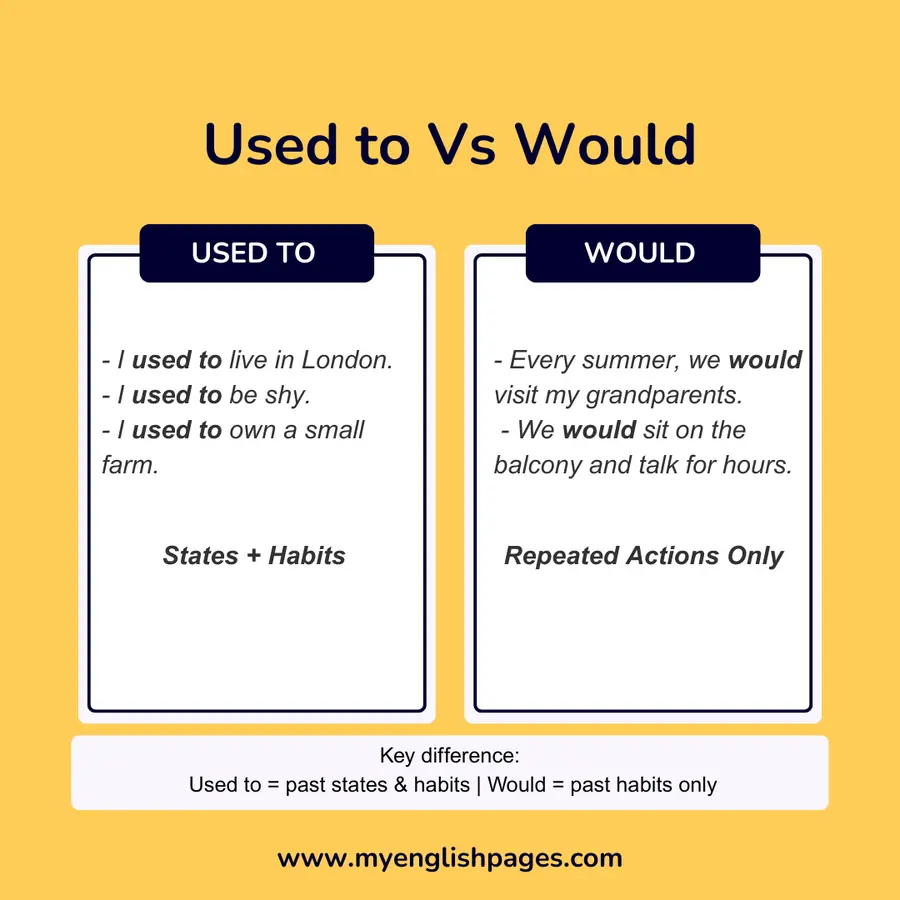
Examples Using Used to and Would
Below are ten clear examples showing how used to and would describe past habits, and when only used to is possible.
- When I was a child, I used to play outside every afternoon.
- (past habit)
- When I was a child, I would play outside every afternoon.
- (past repeated action — same meaning as sentence 1)
- She used to live in Spain before moving to Canada.
- (past state — would not possible)
- Every evening, my father would read us a story before bed.
- (past repeated action)
- My grandparents used to have a small farm near the mountains.
- (past state — would not possible)
- On weekends, we would visit my cousins and play football together.
- (repeated action)
- I used to be afraid of the dark when I was young.
- (past state — would not possible)
- During the summer holidays, the kids would stay up late watching movies.
- (past repeated action)
- She used to like spicy food, but now she prefers mild dishes.
- (past state — would not possible)
- When we lived in the countryside, we would go fishing by the river every Sunday.
- (past repeated action)
Mini-Exercise (With Answers)
Choose the correct option: used to / would
- When I was younger, I ___ ride my bike to school every day.
- My grandparents ___ own a small farm.
- After dinner, we ___ sit on the balcony and talk for hours.
- She ___ be very shy as a child.
- Every Saturday, he ___ clean his room before going out.
2. used to (state)
3. used to / would (repeated action)
4. used to (state)
5. used to / would (repeated action)
Key Takeaways
- Used to → past habits and past states
- Would → past habits only (actions, not states)
- Use would in storytelling to create rhythm and nostalgia
- Use used to when the sentence talks about a situation that was true for a long time